FRAMED IN MOTION
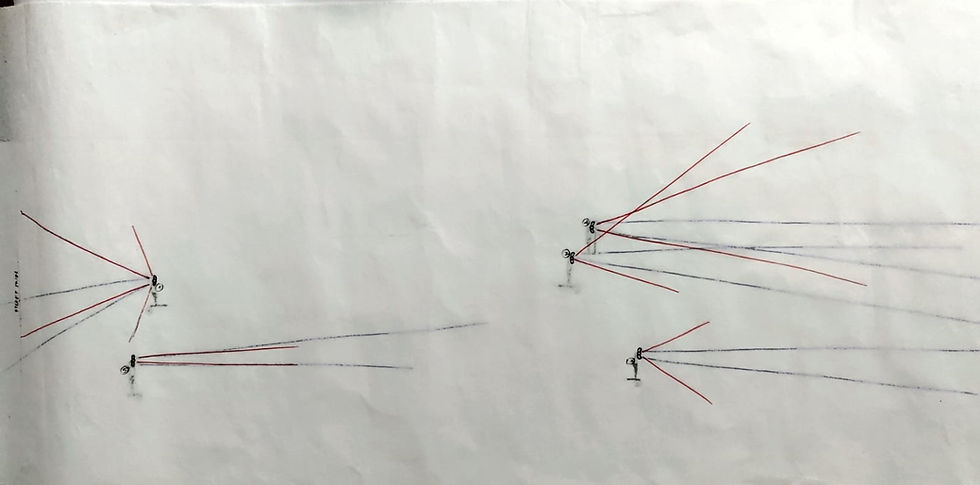
The site forces I was looking at was the shift in vantages and how you perceive the site as you move through the space. I tried to analyze the elements, both visible and invisible, that influence your movement around the space.
Provocation: The site reveals itself through a sequence of shifting perspectives. As I move around, each vantage point offers a different view—creating alternating experiences of openness, enclosure, sometimes appearing larger and sometimes shrinking. These constant changes in perception shape the way the site is experienced. A space is envisioned that responds dynamically to changes in the vantage point by creating various axis' of vision along with varying levels of open and semi-open spaces.

Site Location Map


Site Photos
Since I started looking at the site through the narrow and broad spaces formed and how light shapes the surroundings, the Argumentative drawing I made focuses on the shift in vantages how the perception of space changes accordingly.
I observed how the site revealed itself through different vantage points as I moved around and the constant shift from openness to enclosure, guided by not just the visible elements, but the non-visible ones as well.

Argumentative Drawing

Site Plan

Site Section


Diagrams
THE CONCEPT
The design is based on three simple ideas: changes in levels, shifts in the axis of vision, and transitional spaces.
Small level differences help organise movement and waiting, allowing people to pause, sit or move through the space naturally.
By shifting what is seen and from where, the space offers moments of openness as well as withdrawal.
Transitional spaces tie these together, making the experience gradual rather than abrupt.

Initial Concept Diagram


Iterations
TRANSLATION TO FORM
As the design works with different levels, each level introduced is intended to shift the axis of vision, acting as a frame that shapes what is seen through it. The focus is not only on the levels themselves, but on the spaces formed in relation to them; How the variations in height and depth affect perception and depth.
These changes alter the space above as well as underneath, producing moments of openness, compression, and shelter, allowing the spatial experience to continously transform as one moves through it.


Process and Model Iterations
ROOF
The roof was explored through multiple iterations.
Initially I conceived it as one large entity, gradually sloping in response to harsh light and rain, with slanting slits for wind and controlled light.
Re-imagined as fragmented parts to introduce a sense of openness by introducing a skylight like opening in the centre right above the courtyard.
Final form remains minimally enclosed only where required, creating open and semi-open spaces that direct movement through the day according to the sunlight and shaded areas.


Roof Iterations
THE DESIGN


Design Plan 1:100


